Thursday, April 14, 2011

Mammoth Cave to Illinois

Mammoth Cave to Indiana 4/11/11

We got up pretty early this AM and decided to go on an 845 cave tour. We had seen the dry part of the cave on our historic cave tour yesterday, so today we did a wet part.

The Frozen Niagara tour is short but has a lot to see and has an interesting history.

Mammoth Cave had been a private operation for over 100 years by 1920 when an enterprising person described as an oil man, realized that the cave tours were covering land not owned by the historic tour operators. He managed to surreptitiously map the caverns and bought up adjoining land. He then threw dynamite down a sink hole and blasted a new hole into the caverns. After some exploration he set up a new entrance and built a new hotel and put up billboards calling himself the New Mammoth Cave.

It is amazing to think of people paying the equivalent of $60/person in 1924 to take really dangerous tours. Now there are steel guard rails and steel stairs. Then, forget guard rails, rickety wooden stairs and ladders were what you got for you and your children. People took more chances. And of course the risks you took were your own responsibility. Sort of like skiing now days.

We saw a lot of stalactites, stalagmites, columns and different types of flowstone. We looked into the bottomless pit and also saw the tiny Crystal Lake where people used to climb down to on wooden ladders and ride around in on a tiny boat. The Frozen Niagara was a spectacular tour for little effort.


The weather report was for rain to start at noon so we decide not to camp in Mammoth. It is a pretty campground but has no electricity. We drive on through Kentucky on Scenic route 70.

The idea is to camp at Lincoln State Park in Indiana. There is a historic farm in the area where Lincoln lived from age 7 until he left home. Too rainy to visit today, but little chance of rain tomorrow. At least we have electricity here in this picaresque campground. We could always go to Holiday Village in the town of Santa Claus on the other side of the intersection. Probably not.


Lincoln's Boyhood 4/12/2011

The weather was nice today and we spent the day going around to the various sights around Lincoln State Park that celebrate the boyhood Lincoln spent in Indiana.

In 1816 when Lincoln was 7 his family moved here to a 160 acre claim near Little Pigeon Creek. We visited the Lincoln Boyhood National Memorial including the visitor center museum and movie and the Living Historical Farm. The farm had just opened up for the season and was very enjoyable.
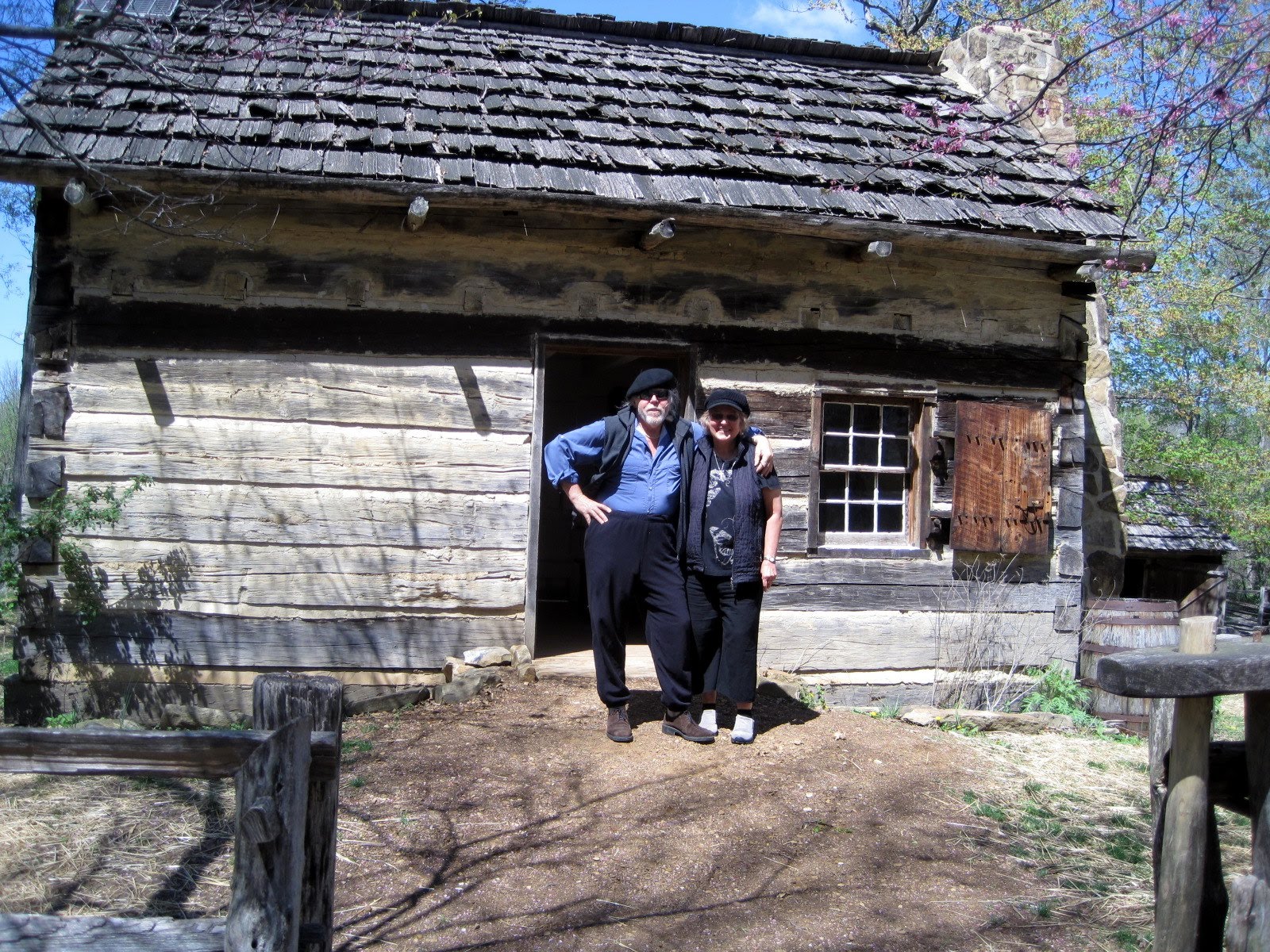
We walked around the Col Jones Home. The Col owned a general store where Lincoln worked. It is still closed. The Abraham Lincoln Bicentennial Plaza was quite impressive.

We walked around the Little Pigeon Primitive Baptist church where Lincoln's sister and her husband are buried. While I fixed lunch William walked up to see Nancy Hanks, Lincoln's mother, grave site.

Lincoln stayed here 14 years. We are camped in Lincoln State Park for 2 nights. We keep changing sites as the RV sites are very uneven. This place is probably packed with people in the summer time.

But it could use a bit of TLC and grader work to level these sites. They offer water and electricity implying that these sites are for RV's. But they are crooked and sloping so it is hard to even roughly level our RV. But we have a nice view of the lake where we are now.

The lake and a ranger cabin, now used for boat rentals, were a CCC project. Reminders from state to state of all the work the young men of the CCC and WPA did in the 30's to fix up our national infrastructure.


New Harmony Indiana 4/13/2011

Just outside Cynthiana, Indiana, I spotted a small clump of headstones on top of a knoll with a large pile of slash next to it piled for burning. No road to this small pioneer cemetery and now no trees to shade the graves. Just cornfields right up to the stones.

As we head west William looks for sights to see along the way. And he picks out New Harmony, Indiana.

They are having Heritage Week, now stamped on my hand. We start at the visitor center for an orientation by a docent and a film. The town is gearing up for their bicentennial in 2014.

In the early 1800's a group broke off from the Lutheran church in Germany and their leader Rapp preached that the end times were near and they should live and work together. They first went to Harmony, Pennsylvania. But they needed more land so they bought 20,000 acres along the Wabash river in a place they called New Harmony. In a few years of hard work they transformed a dense forest into a prosperous town with many industries and surrounding farmlands growing grains, hemp, orchards and vineyards. They exported much of their goods and decided to go back to Harmony, Pennsylvania so their distribution would be better. The sect gradually died off after they espoused celibacy. Like the Shakers.

The town was sold to Owen who wanted to promote scientific study and education. Although he only lasted a few years the people he imported went on to found the Smithsonian Institute.

The town is considered a place where people come to seek spirituality and they have a famous roofless church.The grandparents fountain with William

We have a bit of time to go around to a few of the craftspeople. We see redware pottery making, soap making, rope making, felting and bee keeping and then it is time to leave.

We head out of town and cross the bridge to Illinois. It is a toll bridge, one dollar toll. I think they should pay us to drive on it. It looks to be in terrible shape as the pavement is rutted and the whole thing is covered with rust.

We spent last night in a state park in Illinois at Carlyle Lake. Now we are at Aunt Alice's. She has great internet in her new house.

Sunday, April 10, 2011

Mammoth Cave

Yesterday we saw many red bud by the road. Today we saw tons of dogwood. We are not staying in the campground at Mammoth Cave even though it is much prettier than where we are. One word, electricity.
Diamond Caverns RV Resort says it is associated with Thousand Trails. Thousand Trails has come down a bit. The pool is green. They have stacked large rocks on some of the picnic tables to try to fix the warping. The hot water is slow and the drains back up fast. The wifi is only available in the "clubhouse" I am sitting at a ratty desk with major damage to the wall board. The exercise equipment is a couple of exercise bikes. I've seen better at yard sales. The Sauna is permanently locked and the spa has been broken for 3 years. Definitely downhill.
We went to Mammoth Cave this AM and went on the Historic Tour. It says moderate but I found it pretty strenuous at times.
Total Stairs 440 and a lot of them are straight up out of the bottom. 2 hours, 2 miles. We entered by the natural old entrance and saw the old mining areas. The bat guano was mined to make saltpeter in the 1800's for black powder manufacture and the Indians in ancient times mined the gypsum off the walls for unknown reasons. The narrow and low passages were not too bad. I got the most breathless climbing those stairs back up.

Saturday, April 9, 2011

Great Smoky Mountains and beyond

Great Smoky Mountains 4/5/2011
Snow is spitting down as we leave Mama Gerties RV Park. We see lots of storm damage from high winds and a horrible storm I slept through last night. I have William's cold and was exhausted from all the walking, so I slept through lightning that made William nervous. He said he was wondering what would happen if a lightening strike hit the RV.
Signs are blown over and trees are broken. Looks like in some places the road was just cleared off.
William sees signs of old log skidding on the hillsides so we stop to look.
Since we will be boondocking the next few nights, we want to have plenty of gas. In the gas station window there is a sign for Hot Boiled Peanuts. You dip them out of a crock pot. Your choice of original or Cajun. So I choose Cajun.
At lunch I offer the peanuts with a sandwich. William does not like them. Says they are mushy. Yes, they are soft, but I like them. They make a great treat with a beer later.
Cut and run was the way trees were stripped out of the Appalachian Mountains. “You hardly left a tree of any size standing and all the little 'uns was tore down.” Spruce, Hemlock, Chestnut and Oak all were cut down. Any chestnuts left died off of an imported disease. 85% of the land that became the park was owned by timber companies and had been clear cut.
In the 30's there were many CCC camps here, and you can see all the stone work they did on the road.
In June this area must be lovely with the Rhododendrons in bloom and all the trees leafed out. What we loose in scenery we gain in fewer tourists. It would be even quieter, if this were not spring break for some elementary schools.
There is a lot of water here, and I don't think it all came from the storm last night. William is unimpressed by the Appalachian Mountains. We discuss the difference in age between the Rockies and Sierras and these ancient mountains worn down to what look to us like rounded hills.
Cades Cove 4/6/11
We camped in Cades Cove Campground in the Great Smokies National Park. We are boon docking with no electricity and no phone or internet.
Our main goal today is to do the Cades Cove Tour. This is a combo driving and walking tour of some of the old homes and churches. It seemed crowded enough today. We had trouble finding a parking place at some of the stops. I can't imagine how it is in the summer when it takes 4 hours to just drive the 11 mile route, let alone stop and park and look at anything.
Early settlers chose this land because it was flat. They could grow crops on the flat fields, corn and wheat. They planted gardens and harvested the bounty of the forests. Each family gathered 20-30 bushels of chestnuts just for their own use. If they gathered more, they would sell them in town. Each family had pigs for smoked meat. They ate venison and bear meat for fresh meat. They grew their own cotton and sheep for wool for homespun cloth. They raised cattle on the flat clear land on top of the mountains and also had milk cows.
William tried grinding sorghum cane for juice to make syrup.
The old mill was grinding corn today.

We looked for Borden's but didn't find any.

Although they had peach and apple orchards, the trees are all gone now. The rangers said the bears broke them down soon after the people left, attempting to get all the fruit. These eastern bears must not plan ahead like western bears. There are places in the west where people have long gone but the apple trees are still there. William says bears may break off a limb or two but they do not break down the whole tree.
After dinner William torches off some wood he has found, in the empty campsite next door. It is a nice fire with minimal smoke.
This contrasts with a thankfully further away camper whose fire was billowing black smoke earlier. William said he thought they used inner tubes for starter.
On to Cumberland Gap 4/7/11
We pass through Pigeon Forge on our route and the road from Dollywood is crowded and under construction to make it wider. We pass some really strange businesses trying to capitalize on the popularity of Dollywood. One building is built crookedly sideways and next to it is one built to appear upside down. I see Moonshine brittle and Catshead biscuits, the “largest as seen on TV outlet store”, the Appalachian Aquarium? Too much! Finally we are off the well beaten path and on our way to the Cumberland Gap.
Then we see prisoners working on the roadside in fluorescent orange vests and wide black and white striped pants. I think of George Clooney.
Here we are in a National Park campground that will be shut down if the government shuts down on Friday. We will actually have until Saturday AM before the rangers start telling people to move out. We were only planning on staying here for 2 nights anyway.
William is on a nostalgia trip with the Cumberland Gap as his dad said that the Bakers came to Nebraska from Kentucky and to get to Kentucky, you came over the Cumberland Gap.
We went to the visitor center and watched a movie about the exploration of the region, heavy on the Daniel Boone. I bought a lovely spoon rest made in the area. It has a red chicken footprint on greenish glass. We drove up to the Pinnacle Overlook. We are at the edge of three states, Tennessee, Kentucky and Virginia.
William straddles Virginia and Kentucky.

The Cumberland Gap was not a place of any battles in the civil war although it did pass from rebel to union hands a few times and was the source of much misery to the poorly fed and poorly equipped troops who occupied it.
The campground has just had the hazard trees removed and cut up. There is at least a quarter of a cord of firewood stacked up at each campsite. William is trying to figure out how he can burn a quarter of a cord of wood in one fire circle in one evening.
More Cumberland Gap 4/8/2011
We went over to the Lincoln Memorial University to look at their Lincoln Museum. I think William will be pleasantly surprised by the Lincoln Museum in Springfield. This museum was a bit disorganized. Just lots of bits. But lots of information. I bought a book for Axel.
We looked at the outdoor museum about Daniel Boone and the Wilderness Trail. We had already watched the movie at the Visitor Center.
We drove around the historic town of Cumberland Gap. William said it looked as if they took every old house and made a Bed and Breakfast out of it.
We found the train tunnel. We watched a coal train come out of this tunnel from high above on Pinnacle Overlook yesterday.
Back to the Campground.
On to Mammoth Caves 4/9/11
Today was mostly a driving day. The highlights were tons of red bud blooming along the road, driving through a thunderstorm with piercing lightening flashes striking the ground and bad winds after the storm.
We stopped at Cumberland Falls.
From the write up about the falls
“The falls is 65 feet high and is 125 feet in width. When the Cumberland River is at flood stage the width of the falls can quickly expand to 300 feet.
Besides the falls, one of the great attractions at Cumberland Falls State Park is the Moonbow. Visible on moonlit evenings, the moonbow is said to only be duplicated at Victoria Falls in Africa.”


There did look like a lot of water going over the falls. But having seen high western waterfalls I was not that impressed. We were not there for the moonbow. Maybe then I might have been impressed.
We spent a long time on the Louis B. Nunn Cumberland Parkway. This road is for long distance drives as it has exits only every 15 miles or so. Hardly any traffic. Lots of wind. Named for the 52nd governor of Kentucky, a Republican segregationist who raised taxes to improve the state parks and establish community mental health clinics. Needless to say he served from 1964 to 1971. Another time, another place.

Monday, April 4, 2011

Biltmore House

Today we got up early to be at the Biltmore House close to the opening time of 9AM. We decided to get audio guides to go with the tour. The audio guides were a good investment. If you are paying $44 each for a tour of a house, another $10 each for an audio guide is peanuts. As you go through each room you are cued in the guide book as to what number you input to hear a very well narrated story about the house.
The Biltmore house is the largest house in the USA, currently. There are 250 rooms in the house and 43 bathrooms. It took 20-30 servants to run the house even if there were no guests.
George Vanderbilt was the youngest of the Vanderbilt boys and inherited the smallest portion of the Vanderbilt fortune, which began with George's grandfather Cornelius. Only 10 million dollars. This would be about 225 million in today's dollars. Not too rich by the standards of todays really rich, such as John Paulson, a hedge fund manager who earned 4.9 billion dollars last year.
George and his mother moved into Biltmore on Christmas Eve of 1895. Only half of the rooms were finished. Many rooms remain closed off and are finished to add other aspects to the tour.
In 1930 the Vanderbilts decided to open the house to tours. By making a business out of the house, they avoided having the house taken by the state or other investors for the taxes.
Besides the house tours, they have a hotel, various restaurants, a winery and shops at various locations on the grounds.
The weather was beautiful today with the temperature in the low 80's and a clear sky with a nice breeze.
We are slow tourists. We spent about 3 hours going through the house, had lunch in a restaurant in the converted stables and then spent hours more walking the grounds of the gardens. Though we were tired we drove over to the Winery as we had tickets that came with the house tour for a winery tour and wine tasting.
We bought 3 bottles of wine but no Italian spoon rest, even though I need a new spoon rest.

Sunday, April 3, 2011

Asheville, North Carolina

We were a little late up today and out to the visitor center in Asheville in time for the Noon trolley tour.
This was certainly worthwhile. We would have known little about Asheville and why George Hincapie lives here without this tour.
Asheville had a reputation for healing air and had become a summer vacation site for the well to do and a site for numerous sanatoriums. The air purported to cure TB. But 80% of the patients died anyway. Mental patients came here to be cured also.
We were reminded of Zelda Fitzgerald. She had been a patient for her depression for years and was having electroshock. One day the hospital caught fire and she and a number of other patients died. She and the others had been tied to their beds as they did to patients after they had a treatment. Zelda died in Asheville.
Much of the development of the town came from the wealth of a patent medicine salesman. Quinine was at that time thought to cure many diseases, but it was too bitter to easily take. His tonic was effective against malaria, but of course it was sold as a cure all.
The two main industries are tourism and medical. Just the same as they were when the town began to develop when George Vanderbilt brought the RR here.
After 1929 the town apparently just limped along. Many of the old Victorians were boarding houses or multifamily dwellings and just deteriorated. In the 80's there was a tax advantage for owning a historical dwelling and most were fixed up at that time and many are bed and breakfast inns.


Thomas Wolfe wrote Look Homeward Angel in 1929 about his hometown of Asheville. He changed the name of the town and state, but nothing else. The townspeople were horrified and banned him from the town. When he became famous, they began to publicize themselves as his home town.
We had a little tour of the Biltmore village. We will tour the mansion tomorrow.
As we were nearing the end of the tour the trolley began to rattle and bang. The tailpipe and muffler had come loose. We pulled over near the RR tracks and the driver and a couple of passengers temporarily fixed it with one of the men's leg brace. While we were waiting I took some pictures of nasty kudzu.

We drove a few blocks from the Visitor Center to park in town. Since the garages were out of the question, we found an open air lot with plenty of room for only $3.
I wanted to lunch at one of the most popular eateries in town, The Tupelo Honey Cafe. I figured since it was after 2, we wouldn't have to wait. At first the hostess was not sure, but the pager she gave us started to go off as soon as we sat down.
Asheville is known as a beer city with many microbreweries, so we ordered two microbrews, a light German lager for me and something dark for William.

The treat to eat while you wait is a huge southern butter biscuit and blackberry jam. I had the Veggie Bowl; beans, cheese grits, greens, fried okra and a fresh salsa. William had meat loaf and gravy. It came with mac and cheese, but William substituted a salad. We shared a piece of pecan pie for dessert.

Southerners make great pecan pie.

Saturday, April 2, 2011

North Carolina

This is not the North Carolina I lived in when I was in part of fourth and fifth grade, 1953. We lived near Jacksonville near the coast. Although if we wanted to go to the beach we went to Myrtle Beach, South Carolina. Better beach and I don't think there is much of any beach in North Carolina.
We start the morning with traditional hoe cakes. Not as light as Paula Deen's, but I was using a package of cornbread mix and was unsure of how much hot water to use. Also Pam is not the same as whatever grease you are supposed to fry them in. Very filling. We ate less than half the batch. They should warm up OK again. Also no cane syrup. For Axel's benefit, cane juice is squeezed out of the sugar cane plant stalk. When it is cooked down some, it becomes cane syrup. If it is processed further, you get 2 things, granulated sugar or brown sugar and molasses. Cane syrup and sorghum syrup were the traditional pancake syrups.
The Cradle of Forestry is still closed for the winter. So another change of plans. Although it rained a bit last night, the robins hopping on the grass say spring.
We decide to go to the Folk Art Center on the Blue Ridge Parkway.
William has put in an address and sent it to me on the phone. The trouble is that the address is Blue Ridge Vista, which is a rural/residential area in Riceville somewhere above the Presbyterian Church miles from the Blue Ridge Parkway. The correct address was on the Blue Ridge Parkway. We eventually get to the parkway and from there to the Visitor Center and then to the Folk Art Center.
The Blue Ridge Parkway was conceived of as a way to link this unique Appalachian land and culture. The culture here is a blend of the Scots-Irish, English and German who moved here and the indigenous population of Cherokee and also black mountain communities. The construction of the parkway began in 1935. Italian and Spanish stone masons were brought to work on the road by local contractors and stayed. Part of the benefit of building the Parkway was to provide jobs through the Civilian Conservation Corps and the Works Progress Administration. The CCC and the WPA built picnic areas and campgrounds and did landscaping projects.
The Blue Ridge Parkway is administered by the National Park Service and links a number of National Forests and State Parks. It stretches from Shenandoah National Park in Virgina 469 miles through The Great Smokey Mountains National Park in North Carolina. Tennessee wanted the parkway also, but it didn't work out.
We spent a couple of hours in The Folk Art Center. There is a lot to see from the craft demonstrators, to the shop that sells art from members of the Southern Highland Craft Guild, the art on the wall to the second floor and the hanging art quilts. Upstairs is art from students. The current exhibit is from North Georgia College and State University in Dahlonega, GA.
I am in a shopping mood and buy a lovely pair of red pottery candle stick holders from the craft shop and a CD and a DVD from the Park Service Gift Shop. The CD is Dona got a ramblin mind by the Carolina Chocolate Drops. The DVD is about the Trail of Tears.
We are here in Mama Gerties RV Park for the next 3 days. Interesting hillside location. I am sure it is lovely when the huge rhododendrons bloom, maybe in a few weeks.
I have noticed lots of blooming trees around here that looked a lot like Valerie's driveway pear trees. William just read me a rant from the local paper. Bradford pears, an exotic from China, are invasive here and are out competing local species. The letter writer wants them torn out and trees planted that would provide better food and habitat for local animals and birds. Sort of like the Scotch Broom on the west coast, an ornamental that became invasive. Here they sell Scotch Broom as an ornamental. I guess it does not spread here.

Friday, April 1, 2011

Georgia to North Carolina

Lawrenceville 3/31/2011
Not much of a post yesterday as I was writing with one finger on the phone. Although we were on the interstate highway we still had sights to see as we migrate north. The trees are leafing out in all shades of green and yellow-green, some in shades of red and orange. We see red-buds blooming and lots of dogwood. Wisteria has gone wild and is blooming with lavender splendor in huge patches up in the trees. Flowers are blooming in the median strip, a low lupine and some red and yellow flowers unidentifiable at speed. In the rain yesterday we passed big tractor pulled mowing machines pulled to the side of the highway. No mowing in the rain. No Spanish moss. We have climbed in elevation. The dead looking heaps of vines hanging on the dead trees and bushes it has killed is kudzu. It will green out later. Right now it looks ghoulish and ghostly.
Georgia houses we see remind me of houses in Texas. Big and lots of brick.
It has been lots of years, since we saw Ray and Lori. The last time they were in California, they were in Gridley. Close enough to visit from Nevada City. But we were busy, busy. Busy with kids, jobs and school. Just busy lives. Then in the blink of an eye they were gone from Gridley to Georgia.
Ray retired at exactly the same time as Bill and he has done various part time and consulting jobs as he waited for Lori to retire today, 3/31.
One of his hobbies is backyard birding. In addition to the various special bird feeders has has a bird house with an infrared web camera in it hooked to the TV. No privacy for birds. I found it fascinating to watch the resident chickadee. She is setting on 5 eggs. Even at night she wakes up to turn the eggs.
Ray's backyard is lovely with lots of plantings and a year round creek.
The lawn is only in the front with flowers and flowering bush borders.
Lori has spent a lot of time carefully decorating this house. It really is lovely.
We are climbing north up into foothill mountain looking areas to the Great Smoky Mountains. We are here in Appalachia. William likes the hills and valleys better than the flat lands. The train says Great Smoky Mountains Railroad.
We are now in North Carolina. Just skipped South Carolina.
We are going to spend some time visiting the Eastern Cherokee Nation. Not all the Cherokees went to Oklahoma on the trail of tears. Some hid out and some came back. They now have a nation here. Fourteen thousand are here. There were thirty six thousand before they were driven out of the land they had lived on for eleven thousand years.
We are in Happy Holiday Campground. They have internet here, but my laptop is acting up again. I can still use my programs in safe mode, but I am limited. The gray screen of death comes up now after I tried to do another system restore hoping that would help. Their IT guy tried to help, with no luck. The ducks also wanted to help.
4/1/2011
There was some incompatibility between the Toshiba and the internet connection at Happy Holidays. William had internet but not me. I thought I would have to use the flash drive to transfer data to his computer. Now we are here in Creekwood Farm RV Park on Jonathan Creek Road in Wayneville, NC. and the internet works fine for me. Poor Toshiba to have been so beat on it stressed out to gray screen. I thought I would have to wait to have Cyndi fix it.
We were going to stay longer at Cherokee, but they do not really open much of anything up until May 1. No Play, No Indian Village of 11,000 years ago, No Cultural Center. So we will move on towards Ashville as we do not do Casinos.
Silva is stop number one as William has a cold. I get him some heavy duty stuff from behind the counter. They have to enter all your personal information from your driver's license to get 24 generic cold pills. I approve of this as it has cut down on the meth labs. I also get him some chewable vitamin C. He started feeling better soon after he was medicated.
On to the Mountain Heritage Center at Western Carolina University in Cullowhee, NC. William and I like museums and exhibits and this has elements of our heritage about it. We both have Scots-Irish heritage and this museum tells the story of the Scots-Irish and the further story of those who stayed here in these mountains.
In the 1600's the English were trying to tame the Irish, so they imported low country Scots to colonize the north of Ireland. Some stayed on and fought the Irish for 300 years. Others left for America.
It was a hardscrabble farming life for those who stayed in the Appalachian Mountain Country. Besides the exhibit about the migration there were temporary exhibits on woodworking, food preparation, music and moonshine. Moonshine was important here since their farm cultivation changed from oats to corn. They knew how to make whiskey so corn whiskey was a natural outcome. A high value product that transported well. It moved around well even during prohibition. Al, Bill's dad, told of driving moonshine trucks at age 17 up to Chicago.
The food preparation reminded me of some of the food preservation I did when we lived in Sawyer's Bar. Dried green beans, apple butter and canned crab apples.
Bill claims Scots-Irish on his father's side. The Baker's were farmers in Nebraska. I claim Scots-Irish on my mother's side. The Whitlock's (Barrie, McAdams) were farmers in Illinois.
We go back to Silva to walk the downtown and shop. Reminds me of a combo of Nevada City and Grass Valley. Very nice upscale shops and art shops, but still a beauty shop and barber shop. We buy some nice bread in the bakery, a very nice piece of fish in the fish market, and a knick knack or two. We stop in the Brewery. Very small. Smells nice. But he sells by the growler and we have no room for a growler of beer. I think Nevada City needs a brewery like this. The June company would run through a growler or two and it is quite inexpensive just for a fill up.