Tuesday, April 9, 2013

Fox Glacier to Hokitika


In the Fox Glacier parking lot I get my chance to photograph a Jucy camper van. Jucy is a huge company in New Zealand. They rent camper vans and cars and do tours and cruises, Somehow I think the name would not go over big in the USA with its combination of puritanism and political correctness.

Grandpa spots a rock that says BEN was here. Really?

We spot our first ranger, a metal cutout.

Then we actually spot a real ranger repairing a fence. He says he will soon be extinct. Hmm?

Lots of nice shots of Fox Glacier. Its dirty toe and the black sand remind me of the sand in Barrow, Alaska.
You can barely make out a group of people on the glacier with a guide, near the middle of the picture.
We get a nice shot of Mt. Cook, which was discovered from this west side.

At Franz Joseph Glacier we just walk to Peter's Pool, a kettle lake discovered by Peter Westland in 1894 when he was out camping by himself at age 9. The tomtit's are swooping around on the other side of the pool and two ducks fly over.

We stop by Ross and do a drive through tour of the gold fields. We are very familiar with the progression of gold mining from streams to hydraulic mining and dredging to hard rock mining.

Our last stop today is the Hokitika Museum. Lots of the town history. This building was a library donated by Andrew Carnegie. It was in disrepair and was scheduled to be bulldozed when the historical society saved it, repaired it and made it into a museum.

William is looking for a greenstone (pounamu) pendant. So we look in a few stores and will continue tomorrow.

Sunday, April 7, 2013

Driving to the west coast over Haast Pass


Driving from Wanaka to Fox Glacier.

Barry is climbing a boulder next to our B&B. Time to go.

We start counting the roadkill possums and get to 26. This one is pretty flat. Ever since these animals were brought here from Australia they have been the scourge of native birds, but that was just a“tree hugger” problem. Recently they have been found to be carriers of TB and a problem to farm animals. So suddenly eradication is on the radar.

We stop at a walk to the Blue Pools. Glacial water clear and blue so you can see fish in the water. I am getting slightly used to the swing bridges. Where the paths are board walks they prevent them from being slippery by putting chicken wire on top of the boards. A great inexpensive idea.


Moss on the trees

Red berries. At home I know edible berries, but not here.

The path to Fantail falls is under renovation, so we stop at the ninety foot high Thunder Creek falls. Very nice. William is rejuvenated.

The pools here are also blue.
The Tomtit we see flutters about to quick for a picture. Thanks to wiki for this.

I have been thinking about the kiwi and the moa. When the kiwi hatches it requires no care from its parents. It is a bit smaller than an adult, but all the necessary behaviors are hard wired. It is born knowing how and where to forage and how to build a burrow. Not really any room there for learning new behaviors. Not good if something in the environment changes. I think the moa must have been much like this. In the hundreds of years the Maori hunted the moa, the moa never learned to be afraid of people. There is a lot of impenetrable forest still here in New Zealand. If the moa had been able to learn new behaviors, it could have survived.

We stop at Knights Point to view the ocean. To the west is the Tasman Sea between here and Tasmania. To the southwest is the Southern Ocean between here and Antarctica. On the sand at the tip of the point is a bunch of fur seals, confirmed with William's spotting scope.
I catch one of the ubiquitous safety signs. You see these every once in a while with messages like Drink Drive Die!

The vegetation is thick and lush and in this way reminds us of Oregon or Washington rain forest coast. But not when you look closer. The plants and trees are different. They look more like the background in pictures of dinosaurs. I think about a certain botanist who would love to visit here. Lena!


Arrowtown


Balloons rise over Lake Wakatipu as we get ready to leave.

Arrowtown, pronounced by one host as “Eretun”, is a great place to spend a morning. We head to the museum first. The Queen Mother visited here once. The museum has many corners and two levels. Quite a lot for a very small town.
The large moa were the largest bird ever

Downstairs in the town replica I follow the sign
and open the door on this guy who says to leave him alone

The fabric art exhibit was gorgeous. Too bad no photos allowed. Even though there is video surveillance, one piece was stolen. The thief was caught. A 75 year old woman tourist from England. She threw the piece in a rubbish bin as the police closed in on her. The thought is that she was not all together. The prosecution is on going.

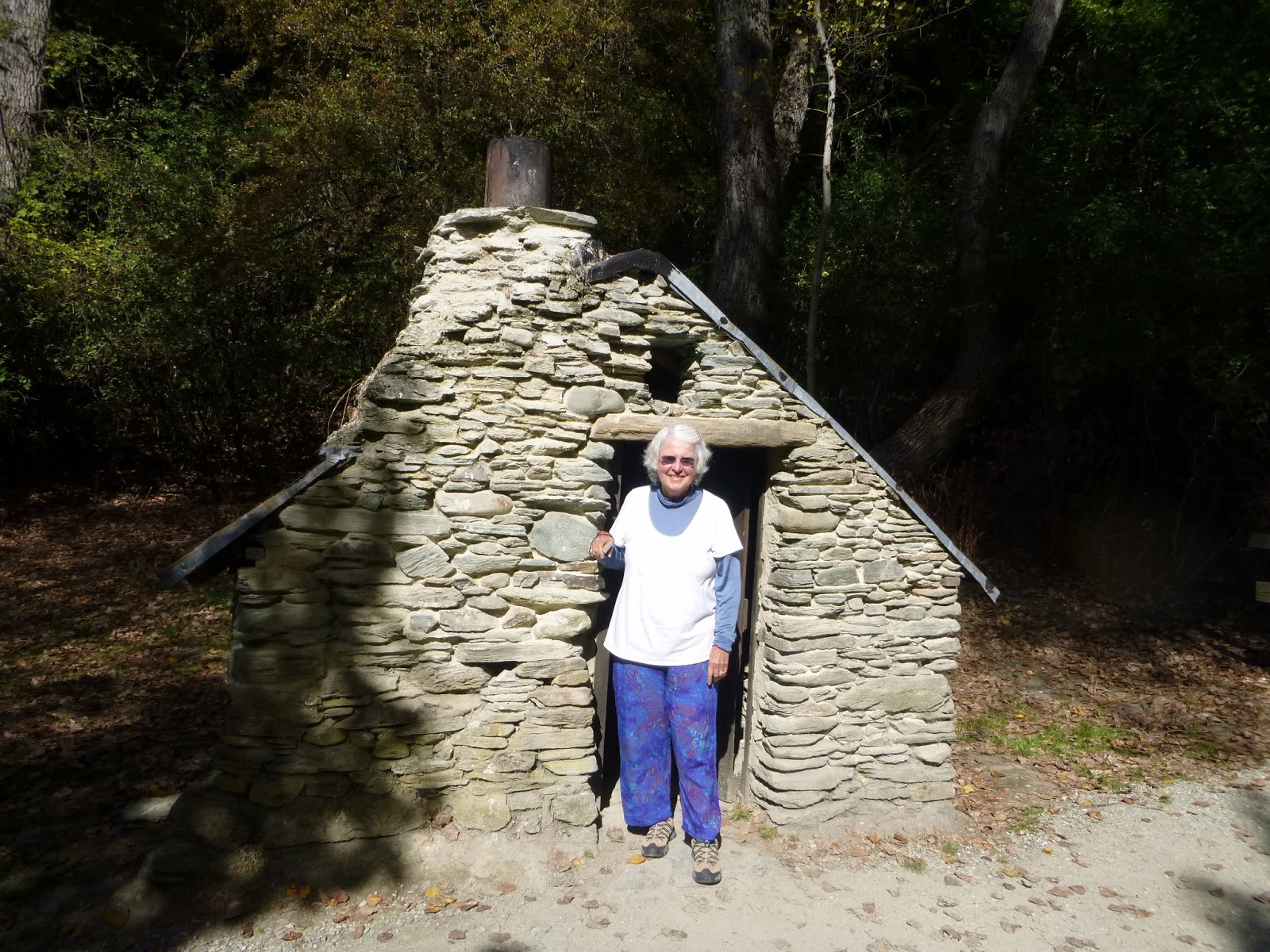
We then head down to the Chinese Quarter. This area is on the edge of the river and is a park now. The Chinese suffered the same as in other areas. After they were invited to come at the end of the gold rush, they were discriminated against and eventually were charged a prohibitive tax to come.


This larger building was the Chinese Store.


We take the high road past some ski areas over the mountain to Wanaka 

where we have another high up room with a balcony.


Saturday, April 6, 2013

Queenstown and Arrowtown


April 5th and 6th

Our last host said it was the end for New Zealand when people arrived. I think about that. New Zealand had only birds, three bats, a few lizards and frogs. The biggest around were birds. The Moa weren't too bright. They were grazers, like cows. The most aggressive and probably most intelligent was the Haast'sEagle.  A giant bird whose talons had the strength of a tiger. So what would have been next on the evolutionary scale for this country? Hawkman?

We spend the early afternoon walking around the Queenstown Botanic Gardens next to Lake Wakatipu. 


Things are multipurpose here. The entire garden is part of a disc golf course. We spot some duffers poorly playing with one old style Frisbee each. But they were having fun. 


 There was also a lawn bowling space and tennis courts. We take advantage of a picnic table to fix our lunch. High tech toilets in the park have electronic locks. Press the red light to lock. Press the green light to unlock.

We are in the top suite of out B&B called the Turrets. We have a huge bedroom, sitting room, walk-in closet/coffee service area. There is a big balcony overlooking the grounds. Lovely. William and the balcony are great friends.


I tried whitebait without really knowing what it was. I was thinking something like small fish, but not tiny babies. They are so small they hardly look like fish when crisply fried, only 2 inches long max. I won't do that again. It is very environmentally wasteful, as these babies would grow up to be regular fish.

After breakfasting downstairs we head back to Queenstown for a crafts fair.
Richard would like these.


And then off to the Kiwi Birdlife Park.

 This is a private conservation effort to save New Zealand plants and wildlife. The area is crowded because most people are here to ride the gondola, play miniature golf or whatever else is up here. The birdlife park is not crowded, but very nice. This hillside was a former informal dump 30 years ago, when the founding family bought it and transformed it by hand into a park with mostly New Zealand native plants. The birds are in aviaries for protection. The area is fenced and they do have traps for predators. They have a breeding program and do release birds where they can into other larger sanctuaries and parks. Some of the permanent resident birds were injured and are unable to leave. They have a half hour conservation show.
They keep one of the prime predators as an example. The Australian Bush Possum that was brought here for a fur industry.

This New Zealand Pigeon does not fly much.

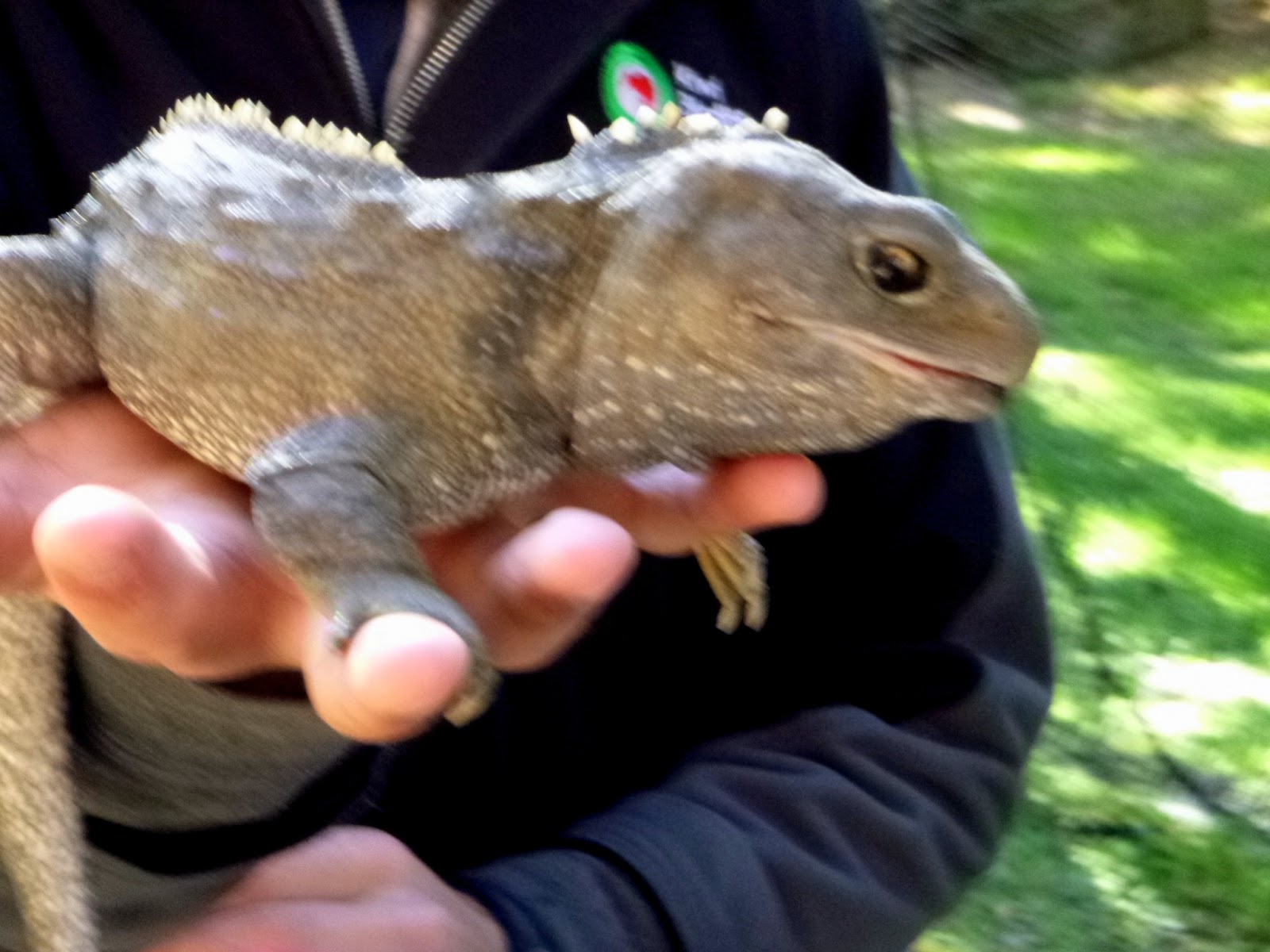
Tuatara, an ancient species 


Kiwi egg replica next to a stuffed kiwi. They lay really huge eggs for their size.
We get to watch the kiwi feeding, almost in the dark as they are nocturnal. They have a kiwi breed and release program.
These ducks are outside the aviary, not inside with the more endangered birds.
Most of the Kea's bright colors are on its wings.
Hawkman or Haast's Eagle Man?

We come back to our digs and make our own lunch. We could go out again, but it is too nice here.